
 EN
EN
How Antiscalants—Key Water Treatment Additives—Inhibit RO Membrane Scaling
Threshold Inhibition and Crystal Distortion Mechanisms Against Calcium Carbonate and Sulfate
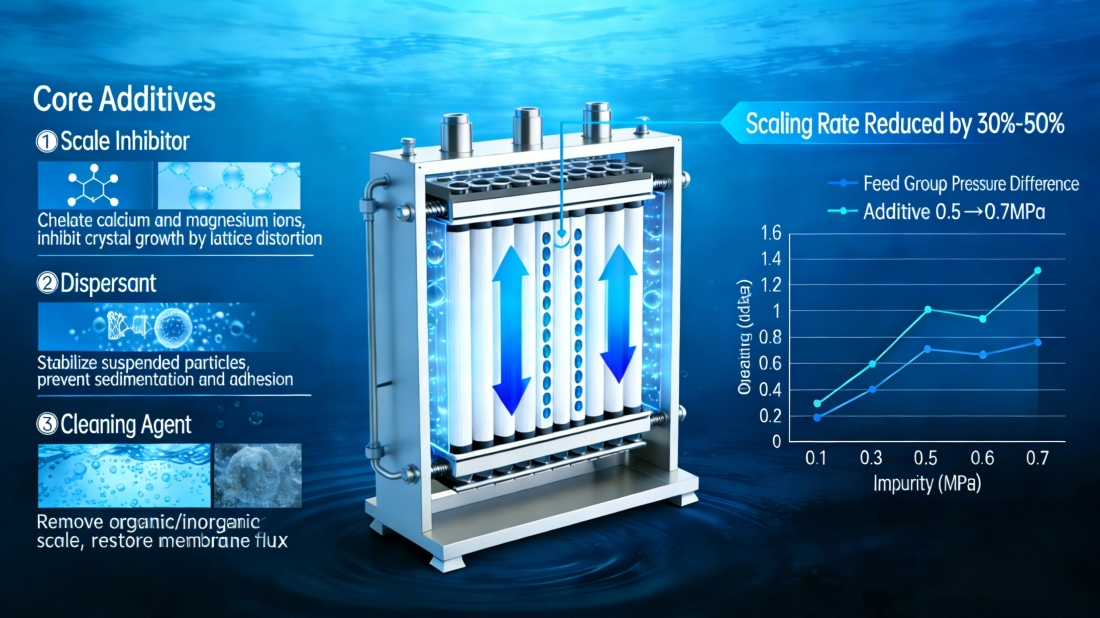
Reverse osmosis membranes often face scaling issues, but antiscalants help tackle this problem using two main approaches: threshold inhibition and what's called crystal distortion. Let's start with threshold inhibition first. Basically, these chemicals stop crystals from forming even when there's way more minerals floating around than should be possible according to normal chemistry rules. Think about it like keeping calcium carbonate, calcium sulfate, and barium sulfate dissolved in water even though they shouldn't be. Now for the second mechanism. When antiscalant molecules stick to those tiny scale crystals just starting to form, they mess up the crystal structure. Instead of growing into nice regular shapes, these crystals become all wonky and don't attach to the membrane surface. They just stay suspended in the water until they get flushed out with the waste stream. Industrial tests have shown that combining both methods cuts down on scaling problems by more than 90% in real world applications, according to latest research published last year.
| Mechanism | Target Scale Compounds | Impact on RO Membranes |
|---|---|---|
| Threshold Inhibition | CaCO, CaSO, BaSO | Prevents crystal nucleation |
| Crystal Distortion | Silica, metal oxides | Creates non-adherent structures |
Performance Benchmarks: Ultra-Concentrated RO Antiscalant in Real-World Applications
Concentrated antiscalant solutions work really well at preventing scale buildup in real world operations. When tested in twelve different manufacturing facilities last year, operators saw almost all the calcium sulfate deposits disappear after implementing better dosage methods. The membranes lasted two to three extra years before needing replacement, and water flow rates only dropped about 5% each year. Because these products are so concentrated, plant managers can fine tune how much inhibitor gets mixed with minerals in the water stream. This matters most when dealing with water sources that have over 2000 parts per million total dissolved solids. Some third party tests back this up too, showing similar results but using 22 percent fewer chemicals compared to standard treatments according to a recent study published in Water Treatment Journal.
Targeted Water Treatment Additives for Silica Fouling Control in RO Systems
Colloidal Silica Dispersion: Stabilization Chemistry and Membrane Surface Protection
Certain additives fight against silica fouling using a two-pronged chemical strategy. These substances give colloidal silica particles a strong negative charge, which creates repulsion forces that stop them from clumping together and clogging pores. At the same time, special dispersant polymers stick to the membrane surfaces, creating protective layers that keep things from sticking. Real world tests indicate that when these programs are properly implemented, they cut down on how often membranes need cleaning because of silica issues by over 40% compared to systems without treatment. Getting good results means keeping the additive levels in feedwater somewhere around 3 to 8 parts per million, adjusting as needed based on changes in silica content and pH levels. The whole package works together to maintain proper flow rates through membranes and significantly prolong their useful life even when dealing with water containing high silica concentrations.
Optimizing Water Treatment Additives Efficacy Through Feedwater and Operational Intelligence
pH, Temperature, and Alkalinity: Critical Levers for Additive Selection and Dosing Accuracy
The chemical makeup of feedwater has a major impact on how well antiscalants work. When the pH changes by just 0.5 units, there's about a 25% jump in calcium carbonate scaling problems at room temperature according to recent research from the Journal of Membrane Science (2023). This shows why we really need dosing methods that can respond to pH changes. Higher temperatures speed up how fast crystals form, so operators often need to boost antiscalant amounts by around 15 to 30% to get the same level of protection. The bicarbonate balance in water is driven by alkalinity levels. For waters with over 200 parts per million of calcium carbonate equivalent, special additives that modify crystal growth become necessary to prevent membranes from getting clogged. Keeping track of all these factors allows for smarter dosing decisions. This becomes especially important in systems where water hardness varies throughout different seasons.
Langelier Saturation Index (LSI) and Silica Scaling Potential Assessment for Proactive Additive Deployment
The Langelier Saturation Index or LSI basically tells us how much calcium carbonate is dissolved in water beyond what's stable. When we see positive numbers on the LSI scale, that means scaling problems are right around the corner. With silica, things get a bit different because temperature plays such a big role. We adjust our saturation calculations according to temperature changes. At about 150 parts per million of silica dioxide when temps hit 30 degrees Celsius, most facilities start looking at adding special dispersants to their systems. Modern water treatment plants now have sensors that monitor these saturation levels continuously. These smart systems automatically inject antiscalants whenever readings go past what's considered safe. Plants that implement these kinds of predictive maintenance strategies report cutting down unexpected membrane failures by roughly 40%. The savings come from fixing issues before they become major headaches.
Key Implementation Notes
- Data Integration: Connect SCADA systems with IoT water quality sensors for live LSI and silica saturation tracking
-
Dosing Protocols:
- Calcium-dominated scaling: Prioritize threshold inhibitors
- Silica-rich waters: Deploy dual-function dispersant-antiscalants
- Verification: Quarterly membrane autopsy validates additive efficacy against evolving local water chemistry
This balanced, intelligence-driven strategy prevents irreversible flux decline while minimizing chemical use and operational disruption.
Selecting and Validating Water Treatment Additives for Long-Term RO System Reliability
Picking the right water treatment additives isn't something that can be done with general guesses or assumptions. Water plant operators need to test these additives under real world conditions first. That means running tests with actual feedwater samples, checking how they perform at different temperatures, and seeing what happens with various system recovery rates before making any decisions. Keeping an eye on things like permeate quality, pressure differences across membranes, and concentration levels gives concrete data points that help adjust dosages properly over time. Plants that follow this systematic approach often see cleaning needs cut in half compared to traditional methods. The membranes last longer too since there's less chance of permanent damage happening. Instead of just being another line item on the budget sheet, good additive management becomes part of maintaining clean water consistently while protecting equipment investments for years to come beyond the standard five year mark most facilities expect.
FAQ Section
What are antiscalants? Antiscalants are chemical additives used in water treatment to prevent scale formation on reverse osmosis membranes by inhibiting crystal growth and distortion.
How do threshold inhibition and crystal distortion work? Threshold inhibition prevents crystal nucleation when mineral concentrations are high, while crystal distortion alters the shape of growing crystals, making them less adherent.
Why is proactive additive deployment essential? Proactive deployment using tools like LSI helps monitor and adjust antiscalant usage as per scaling potential to lessen unexpected membrane failures.
What are the effects of pH and temperature on antiscalant efficacy? Changes in pH and higher temperatures can increase scaling, requiring refined dosing strategies to maintain antiscalant efficiency.
Why is it important to test additives under real-world conditions? Testing additives with actual feedwater samples ensures appropriate dosing based on temperate, recovery rates, and local water chemistry, thus optimizing performance and reducing cleaning needs.
Table of Contents
- How Antiscalants—Key Water Treatment Additives—Inhibit RO Membrane Scaling
- Targeted Water Treatment Additives for Silica Fouling Control in RO Systems
- Optimizing Water Treatment Additives Efficacy Through Feedwater and Operational Intelligence
- Selecting and Validating Water Treatment Additives for Long-Term RO System Reliability