
 EN
EN
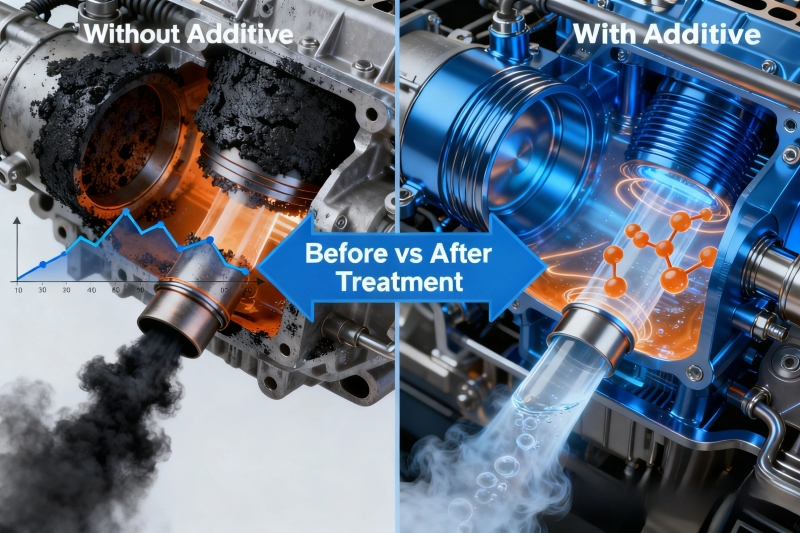
How Fuel Additives Work to Reduce Emissions
Chemical pathways: Oxygenated, cetane-improving, and catalytic additives altering combustion chemistry
Additives for fuel work their magic by changing how fuels burn at a molecular level. Take ethanol based products for instance they bring extra oxygen into the fuel mix which helps get rid of those pesky carbon monoxide molecules and leftover hydrocarbons, turning them instead into CO2 and water vapor. For diesel engines, there are things called cetane boosters like EHN that make the fuel ignite better. They shorten that waiting period before combustion starts, so the engine runs smoother overall. Then we have these catalytic additives with metals in them, cerium oxide being one common example. These substances basically make it easier for the fuel to start burning because they reduce what chemists call activation energy. The result? Cleaner burning happens even when temps aren't super high inside the engine. All these different chemical tricks happen right in the combustion chamber itself, cutting down on those half burned residues that create pollution problems. Most manufacturers report significant reductions in harmful emissions when using properly formulated additive packages.
Thermodynamic effects: Faster flame propagation, shorter ignition delay, and more uniform combustion
Certain chemical additives can boost how well engines burn fuel by fine tuning important heat-related processes inside the engine. When cetane improvers are added to diesel fuel, they cut down on the time it takes for fuel to catch fire after being sprayed into the engine chamber sometimes around 30% or so. This means the fuel ignites quicker once injected, which helps create a more even spread of flames throughout the combustion chamber. Without these additives, there tend to be spots in the cylinder where too much unburned fuel collects, leading to those pesky particles we call PM pollution. Better combustion control also keeps things from getting too hot in there, which is good news because high temps are what make those harmful NOx gases form in the first place. All told, this results in better overall engine performance, saves on fuel costs, and cuts down on both standard air pollutants and CO2 emissions at the same time.
Targeting pollutants: How additives suppress CO, NOx, THC, and particulate matter at the source
Today's fuel additives work by cutting down on certain harmful emissions through their chemical makeup. When oxygenated compounds get mixed in, they help lower carbon monoxide and total hydrocarbons because they make sure the fuel burns more completely, especially when there isn't much oxygen available. Some additives contain metals like cerium or iron which actually speed up the burning of soot particles inside the engine. Research has found that this can cut particulate matter emissions from engines by anywhere between 18 to 31 percent. A few special blends manage combustion temperatures too, which helps keep nitrogen oxide levels down without hurting how well the engine runs. What makes these additives really valuable is that they tackle several pollution sources at once. They act as an extra layer of protection before exhaust gases even leave the engine, all while making combustion more efficient and helping vehicles go further on each tank of gas.
Oxygenated Additives and Cleaner Combustion in Gasoline and Diesel Engines
Oxygenated additives enhance combustion efficiency by increasing oxygen availability in the fuel blend, supporting more complete oxidation and reducing carbon monoxide and unburned hydrocarbon emissions.
Ethanol and 1-butanol blends: Reducing carbon monoxide and hydrocarbon emissions by up to 22%
Ethanol and 1-butanol are well-established oxygenates that, when blended into gasoline or diesel, can reduce CO and hydrocarbon emissions by up to 22% (SAE 2020). Their high oxygen content supports more thorough combustion, especially under lean-burn conditions where oxygen is otherwise limiting, resulting in fewer partially combusted byproducts.
Trade-offs in NOx and PM reduction under high-load diesel operation
Oxygenates do a good job cutting down carbon monoxide and hydrocarbons emissions, but when it comes to nitrogen oxides and particulates during heavy diesel loads, results aren't so clear cut. More oxygen means hotter burns inside the engine, which actually tends to boost NOx production. Researchers have noticed something interesting too there seems to be a small increase in those tiny ultrafine particles according to work published in Combustion and Flame back in 2017. However, the total amount of soot usually goes down. What this all points to is that different pollutants behave differently depending on how hard the engine is working at any given moment.
Nanoparticle and Metal-Based Catalyst Additives for Advanced Emission Control
Al2O3 and CeO2 nanoparticles: 18–31% reduction in engine-out PM and enhanced soot oxidation
Certain nanoparticles like aluminum oxide (Al2O3) and cerium oxide (CeO2) act as catalysts inside engine cylinders, boosting heat transfer and helping fuels burn more completely. When around 50 to 100 parts per million of CeO2 gets mixed into diesel fuel, studies indicate that particulate matter emissions from engines drop between 18% and 31%. Carbon monoxide levels go down too, along with those pesky hydrocarbon leftovers. What happens here is pretty interesting actually. The cerium works through surface reactions and gives off oxygen during burning, creating these active oxygen molecules that attack soot particles. This two pronged approach cuts back on soot creation right from the start and also tackles built up carbon deposits already sitting in the combustion chambers. Mechanics working on modern engines have noticed cleaner chambers over time when these additives are used regularly.
Iron and cerium compounds as in-fuel catalysts: Boosting efficiency and reducing NOx-PM trade-offs
The addition of iron and cerium compounds is making headway against the long-standing problem of balancing NOx and PM emissions in diesel engines. These additives work by reducing ignition delay times and creating more even combustion patterns inside the cylinder. As a result, smoke levels drop significantly — some tests show reductions of around 40-45% — without causing major spikes in nitrogen oxide production. What makes these catalysts particularly useful is their ability to function effectively over a wide range of operating temperatures, so they keep working whether the engine is running under light load or full power. This stands in contrast to traditional exhaust treatment methods which only tackle pollutants after they've already formed during combustion. Instead, fuel-borne catalysts address the issue right from the start of the process, providing cleaner results with fewer components needed for emission control overall.
Cetane Improvers and Their Impact on Diesel Emissions
2-Ethylhexyl nitrate (EHN): Real-world effects on CO, HC, NOx, and smoke opacity from NEDC testing
EHN, or 2-ethylhexyl nitrate, works as a popular additive for improving diesel fuel's cetane number, which basically means it helps diesel engines ignite faster. When tested according to the old NEDC standards, adding EHN to fuel was found to cut down carbon monoxide and hydrocarbon emissions by around 15 percent because the fuel burns more completely. What happens with nitrogen oxides depends on how hard the engine is working. At lower loads, we see drops of up to 8% in NOx emissions, but when engines run at full power, temperatures get so hot that NOx actually goes up by about 1.8%. The good news is smoke levels and particulate matter usually drop somewhere between 10 and 20% since better ignition makes everything burn cleaner. For older diesel engines, EHN provides an affordable emissions reduction option without needing any expensive hardware changes. Of course, actual results depend heavily on specific engine designs, how they're operated day to day, and what kind of base fuel gets mixed with the additive.
Fuel Additives vs. Aftertreatment Systems: Efficiency, Cost, and Practical Limitations
Comparing fuel additives with catalytic converters: Emission reduction per dollar, durability, and integration challenges
When it comes to controlling emissions, fuel additives and aftertreatment systems such as catalytic converters take completely different paths. Fuel additives work by changing how combustion happens inside the engine itself. They don't need any mechanical modifications to the vehicle, have relatively low initial costs, and can be easily added to regular fuel supplies without much hassle. The downside? These additives must be used continuously to maintain their effect, so they might actually raise operating costs over time. Catalytic converters offer something else entirely. They last longer and cut down on harmful gases like carbon monoxide, nitrogen oxides, and hydrocarbons very effectively. But there's a catch too these systems come with hefty installation prices, need proper space in the vehicle, and require regular maintenance checks. Looking at cost per gallon usually tells us that additives make better sense for smaller fleets or when dealing with various kinds of engines. On the flip side, aftertreatment systems tend to perform better in situations where vehicles run constantly for long periods. Most businesses find themselves somewhere in between, often combining both methods to get the best results possible given their particular circumstances.
FAQ Section
What are fuel additives, and how do they reduce emissions?
Fuel additives are substances added to gasoline or diesel fuel that alter the combustion process and improve engine performance. They reduce emissions by enhancing fuel burn efficiency, aiding in complete oxidation, and reducing harmful pollutants at the source such as CO, NOx, THC, and particulate matter.
Can fuel additives replace catalytic converters?
While fuel additives provide a convenient way to reduce emissions directly within the engine, they may not fully replace catalytic converters, which are designed to further clean exhaust gases before they exit the vehicle.
How do cetane improvers work in diesel engines?
Cetane improvers like 2-ethylhexyl nitrate (EHN) enhance the ignition quality of diesel fuel, helping it to ignite more quickly once injected into the combustion chamber, thereby reducing delay times and improving combustion uniformity.
Are there any trade-offs when using oxygenated additives?
Oxygenated additives significantly reduce CO and hydrocarbon emissions but can lead to increased NOx production under high-load diesel operation due to higher combustion temperatures.
Table of Contents
- How Fuel Additives Work to Reduce Emissions
- Oxygenated Additives and Cleaner Combustion in Gasoline and Diesel Engines
- Nanoparticle and Metal-Based Catalyst Additives for Advanced Emission Control
- Cetane Improvers and Their Impact on Diesel Emissions
- Fuel Additives vs. Aftertreatment Systems: Efficiency, Cost, and Practical Limitations